FraudLens: an imbalance-aware fraud detection workflow
An end-to-end pipeline built around the defining challenge of fraud detection: the outcome you care
about most is the one standard accuracy metrics ignore. Model comparison, cost-based threshold
tuning, and an AI explainability layer, all grounded in real, verifiable numbers.
Fraud is a needle in a 284,807-transaction haystack
In this dataset (the Kaggle/ULB Credit Card Fraud benchmark), fraud accounts for just 0.17% of all
transactions. A model that predicts "not fraud" every single time scores 99.8% accuracy and catches
zero fraud. That single fact shapes every decision in this project: which models to compare, how to
evaluate them, and where to set the line between a flag and a pass.
Methodology
Three approaches to the imbalance problem, compared honestly
Rather than picking one technique and hoping it works, all three standard approaches were trained on
the same engineered features (transaction velocity, rolling amount z-score, hour-of-day risk windows)
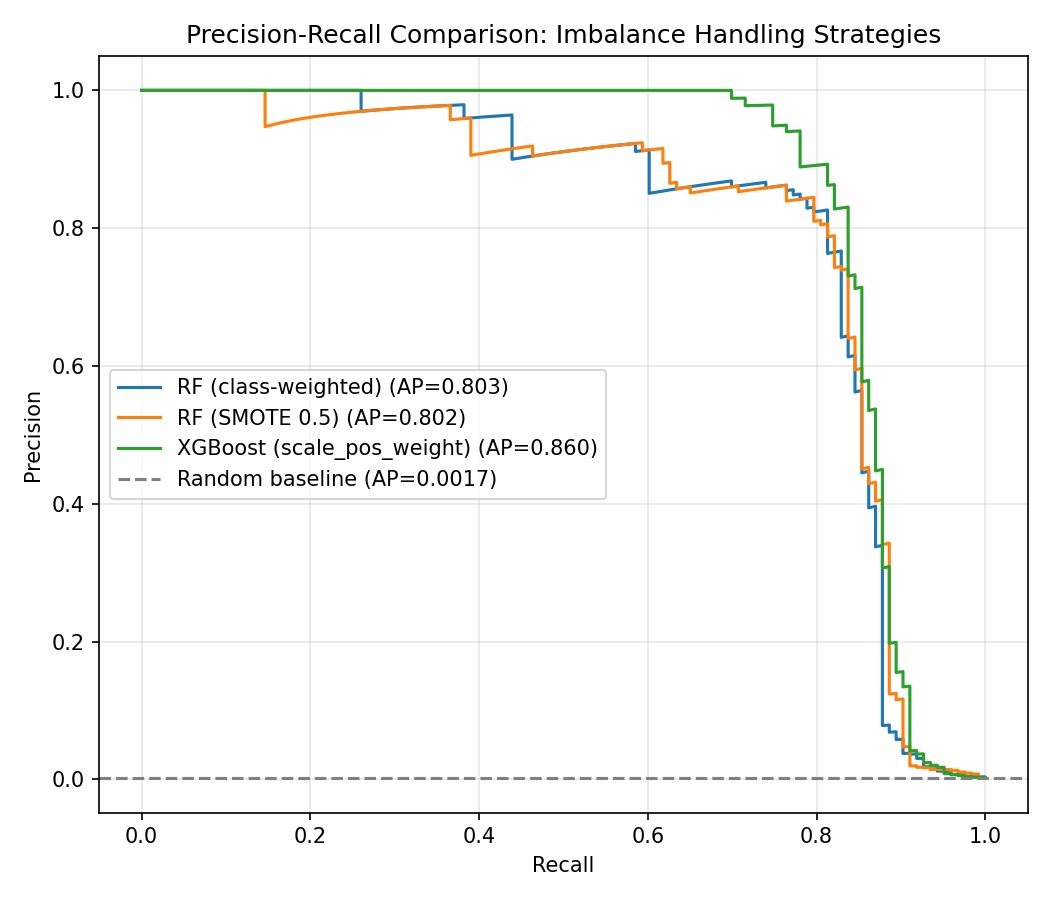
and evaluated on the same held-out test set, then ranked by Average Precision, since accuracy would
be meaningless here.
Approach 1
Class-Weighted Random Forest
Penalises misclassifying the minority class more heavily during training, no resampling needed.
0.804Average Precision
Approach 2
SMOTE-Resampled Random Forest
Synthetically oversamples fraud cases in the training set to ease the imbalance before fitting.
0.802Average Precision
Approach 3 · Winner
XGBoost, scale_pos_weight
Gradient boosting with a built-in imbalance correction term, no resampling or class weighting needed.
0.860Average Precision
Results
The threshold matters as much as the model
XGBoost won on Average Precision, but the more interview-relevant result is what happened next:
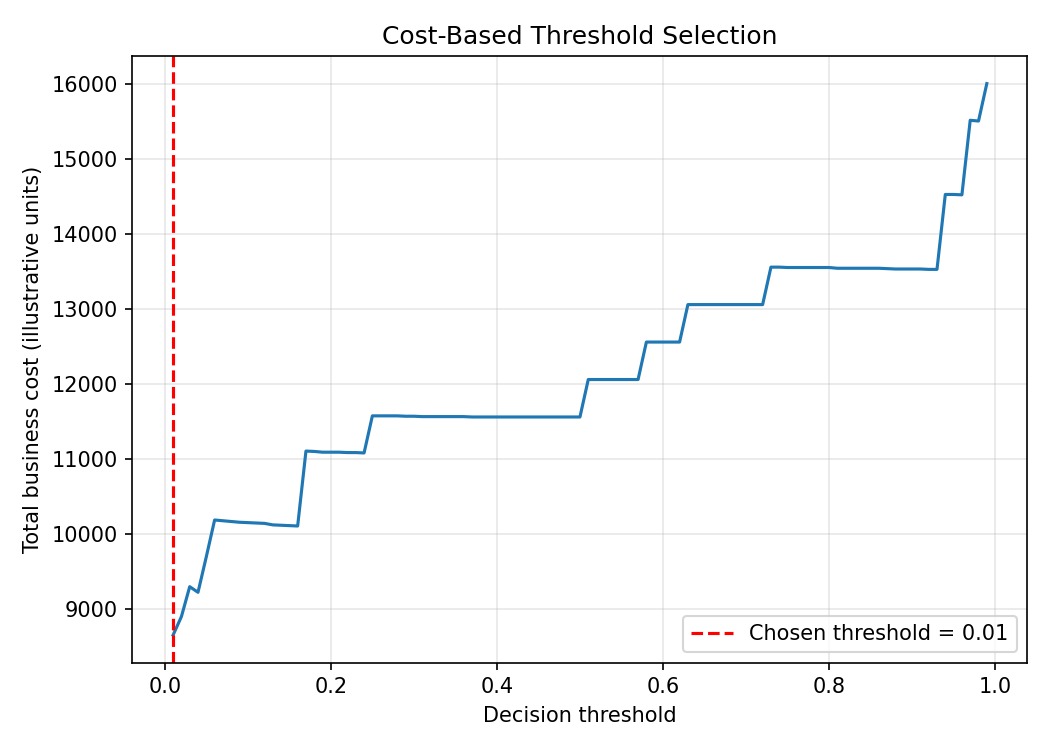
tuning the decision threshold against an explicit business cost (a missed fraud costs far more than
a false alarm) rather than leaving it at the default 0.5 cutoff.
Precision-recall comparison across all three strategies. XGBoost holds precision longest as recall increases.
Threshold
Precision
Recall
F1
Default (0.5)
0.893
0.813
0.851
Cost-tuned (0.01)
0.452
0.870
0.594
Total illustrative business cost by threshold. The chosen threshold (0.01) minimises total cost given a missed fraud is far costlier than a false alarm.
At the cost-tuned threshold, recall rises from 81% to 87% of all fraud caught, at the price of
precision falling from 89% to 45%. That trade is not a flaw in the model, it is a deliberate business
decision: given this illustrative cost ratio, the system should accept more false alarms in exchange
for catching nearly nine in ten fraud cases. A different cost ratio would call for a different threshold.
Explainability Layer
A risk score is not something an analyst can act on
The model outputs a probability. An analyst needs a reason. This layer calls the Claude API to convert
a flagged transaction's feature values into a short, grounded explanation, turning the model from
"a score" into a tool someone would actually use.
"Flagged due to an amount far above this 5-minute window's typical transaction, occurring during a
low-activity overnight window with unusually frequent transactions in the preceding minute."
Honest Limitations
Worth raising before anyone else does
No account ID in this dataset. Velocity and "typical spend" features are computed globally across all cardholders, not per account. In production with account IDs, the same feature logic applies via a groupby on account.
The cost figures are illustrative. The threshold-tuning method is the deliverable, not the specific placeholder numbers, a real deployment would use the business's actual fraud-loss and review-cost figures.
The PCA-anonymised features (V1 to V28) have no real-world meaning. The explainability layer reasons only over engineered features that are human-interpretable, by necessity.
See It Yourself
Full code, dashboard, and write-up on GitHub
The repository includes the feature engineering pipeline, all three trained models, the cost-tuning
logic, the explainability script, and an interactive Streamlit dashboard.